BLAKE's ANCESTRY
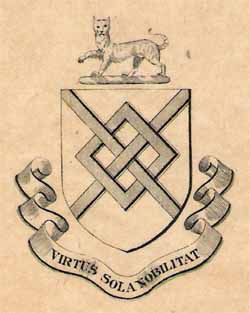
Blake Coat of Arms - Galway County Ireland
("Virtue alone enobles")
Courtesy of Elisabeth Bacque
Verschoyle
Benson
Blake (1899-1971) was a pioneer historian and an early pioneer in
the conservation movement.
The illustrious pedigree of Verschoyle B. Blake
also
shows several distinguished and prominent intellectuals including:
-
THE RIGHT HON.
EDWARD BLAKE
(1833-1912)
leader of the federal Liberal Party
(1879-1887), provincial premier
and
Chancellor of the University of Toronto
(1876 to 1900)
-
WILLIAM HUME BLAKE
(1809 - 1870) Solicitor-General for Canada West (1848) and the Chancellor of
Upper Canada in 1849
-
REV. BENJAMIN CRONYN
(1802-1871) elected first Bishop for the Diocese of Huron (Anglican Church
of Canada) - area comprised of 12,000 square miles in southwestern Ontario
-
THOMAS BENSON
(1804-1857) First Mayor of Peterborough. In 1853 - settled in Port Hope
-
Judge THOMAS M. BENSON (1833 – 1915)
-
AP-LAKE, one of the knights of King Arthur's Round Table
"Every man is an omnibus in
which his ancestors ride."
Oliver Wendell Holmes
BLAKE FAMILY
Verschoyle B. Blake was descended from a lineage of strong intellectuals - the
Blakes of Galway (Ireland). The Blake Family were devoutly evangelical
Anglicans and one of the most powerful families in the area. They were
also very active in city government.
The Blake pedigree is recorded in the Office of Arms, Dublin Castle in great
detail. The original Welsh spelling of Blake was Aplake,
meaning "the family on or by the lake."* Through the centuries, the spelling of
A'Plake changed to Blaake, and last to Blake.
A corruption of the British Ap Lake, from Ap, signifying from, or son,
and Lake --the son of Lake. The family went into Ireland with Strongbow, where
the name became corrupted into Blake. Ap Lake was one of the knights of Arthur's
Round Table. Describing the Blake family’s origin, in 1820 James Hardiman
wrote:
“This family is of British extraction, and, though the name seems derived from
the Saxon, Blac, a colour; yet, Debrett, in his Baronetage, says, "they are
traditionally descended from Ap-lake, one of the knights of King Arthur's round
table,'' and adds, ''that in the reign of Henry II, one of this family
accompanied Strongbow, and after many exploits built himself a castle, at Menlo,
near Galway.'' --- Richard Caddell surnamed Blake, (from whom, according to
Lynch's MS. the Blakes of Galway are descended,) was sheriff of Connaught,
Vicecomes Conacioe, 32 and 33 Edw. I, he was also sheriff in 1306. and in 7 Edw.
Il. the king's writ issued, for arrearages of his account. --- Rot. Mem. --- The
arms of this family were first borne by him and descended to his posterity. The
family of Ardfry, descended from Sir Richard Blake, who was speaker or chairman,
of the assembly of the confederate catholics of Ireland, at Kilkenny, in 1647,
was raised to the dignity of the peerage, in the year 1800, in the person of
Joseph Henry Blake, Esq."
The Blakes were one of the fourteen tribe families of Galway.
From the 16C to 19C, the Blakes were among the most extensive landowners
in the area and one of their principal estates was at Ardfry, Co. Galway.
Many early members of the Blake family associated with the Ardfry name include:
Robert Blake of Ballinacourt and Ardfry (d. 1615), Sir Richard Blake of Ardfry,
Mayor of Galway (d. before 1663), Richard Blake of Ardfry and Wallscourt
(d.1697), Richard Blake (d. 1754), Joseph Blake of Ardfry (d.1806).
Strategically located on the innermost shore of Galway Bay in the heart of
Gaelic Ireland, Ardfry Castle was granted to the Blakes in 1612 and steeped in a
colourful history. Ardfry had many eccentric
owners, one of whom was known to walk around the house naked carrying a cowbell
to forewarn the maids. Another, the last Lord Wallscourt's widow, was a gambler
who sold off the lead from the roof to pay her debts.
Continuing their strong involvement in government affairs,
the Blake family came to Upper Canada from Ireland in the early nineteenth
century, where William Blake (1809-1870) and his son Edward (1833-1912) became
distinguished in law and the administrative affairs of Canada.
The name Verschoyle has old Celtic roots tracing back to Ireland. Other
relatives of Verschoyle B. Blake
include:
Samuel Verschoyle Blake (youngest son of Edward Blake);
Harold Verschoyle
Wrong (son of Professor George M. Wrong) and Verschoyle
Cronyn (the son of Rev. Benjamin Cronyn).
The Blake
Family was linked with the
Cronyn,
Wrong and Benson
families
by
marriage.
William
Hume Blake (1809-1870)
- (VBB's great grandfather)
William Hume Blake immigrated to Upper Canada from Ireland. A
leading lawyer of his time and a pioneer in legal education at King's College in
Toronto, he initiated significant reforms in the Upper Canadian judicial system.
In 1848, he became Solicitor-General for Canada West, and in 1848-1849 he
effected the reforms to the judicial system of Upper Canada for which he is most
remembered. In 1849 he was appointed Chancellor of Upper Canada. From 1853 to
1856 he was also chancellor of the University of Toronto. He married his cousin
Catherine Hume and had four children: Edward, Anna, Sophy, and Samuel
Hume.
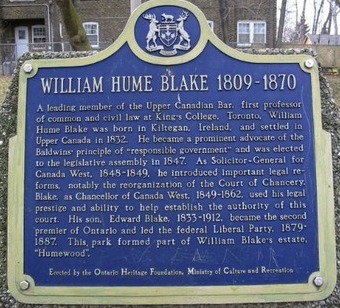
Provincial Plaque - William Hume Blake
(Dominick) Edward Blake (1833-1912) -- paternal grandfather of VBB
One of the great political intellectuals of Canada's past and a National Historic Person of Canada, The Hon. Edward Blake
was leader of the federal Liberal Party
(1879-1887) and the first
Liberal Party Premier of Ontario after Confederation. He was responsible
for establishing the Liberal dynasty that ruled in Ontario from 1871 to 1905.
Edward Blake was also a Federal Cabinet Minister, a Constitutional Lawyer
instrumental in the establishment of the Supreme Court of Canada and the Chancellor of the University of Toronto (1876 to 1900).
His 1874 Aurora Speech urged development of a Canadian Spirit.
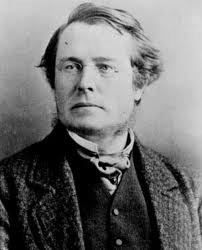
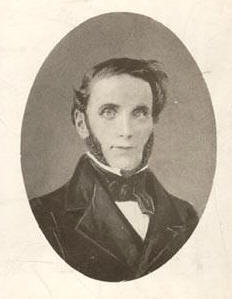
The Hon. Edward Blake
Edward Blake was not only a distinguished lawyer but a brilliant orator whose
speeches which sometimes lasted six hours.
Blake was the co-founder of Blake, Cassels & Graydon,
or Blakes for short, one of Canada’s largest law firms).
In 1858, Edward Blake married Margaret Cronyn (1837- ), second
daughter of the Right Reverend Benjamin Cronyn, Bishop of Huron. They had seven
children, of whom three died in early childhood. The sons, Edward Hume, Edward
Francis (Ned) and Samuel Verschoyle, all entered the family law firm. Their
daughter, Sophia Hume, married Professor George MacKinnon Wrong who was in
charge of the History Dept. at the University of Toronto.
Professor Wrong played a key role in the development of the historical
profession in English-speaking Canada.
George MacKinnon Wrong (1860-1948)
-- VBB's Uncle
Designated a National Historic Person of Canada, George M.
Wrong was almost certainly Blake's favorite uncle and most influential
mentor. They had country homes near one another
(Durham House in Canton and Ardfree on the 9th
Concession north of Port Hope).
After the death of Edward Blake, George bought the property that included a
miller’s house on a pond at Canton north of Port Hope. Blake arrived later.
Both properties had large ponds connected by
the Ganaraska River.
Despite his heavy workload, Wrong generously gave extra attention to his young
nephew for different reasons. Wrong
lost his son, Harold Verschoyle
Wrong (1891-1916) in WW2
(whose body was never recovered).
Blake lost his only brother in the same battle at Thiepval (Somme). The
fact that young Blake
had also lost his father as a young boy (6 years of age) may have propelled
Wriong into a more fatherly role with his young nephew.
Sophia Hume Blake, the eldest daughter of Edward Blake
and Frances Margaret Cronyn, married
George McKinnon Wrong in September 1886. For Wrong, this marriage to the
daughter of the leader of the Canadian Liberal Party and Chancellor of the
University of Toronto, signalled his entry into high society. They had five
children, Margaret (Marga) Christian, Edward Murray, Harold Verschoyle
, Hume and Agnes (Polly). The Wrongs had residences in Toronto at 467 Jarvis
Street and later at 73 Walmer Road in Toronto.
George M. Wrong was born on a farm in Elgin County, Canada
West on June 25, 1860. He was ordained in the Anglican ministry in 1883
and for the next nine years he was a lecturer in history and apologetics at
Wycliffe College. In 1892 he was appointed lecturer in history at the University
of Toronto and promoted to professor and head of the department in 1894. He
remained in that position until his retirement in 1927 and was recognized as a
superb lecturer. He introduced Canadian history into the curriculum and in 1904
founded the University of Toronto Historical Club, with its dominant interest in
public affairs.
In 1897, Wrong founded the
Review of Historical Publications Relating to Canada, predecessor to the
Canadian Historical Review. He was the founding editor of the
Canadian Historical Review, from 1920 to 1927. In 1905 he helped found the
Champlain Society, was its editorial secretary until 1922, and its president
from 1924-1928. Wrong was elected to the Royal Society of Canada in 1908.
An anglophile and an imperialist - he was a founding member of the Round Table
movement in Canada. In 1944 he was elected an honorary member of the American
Historical Association, the third person to receive that honour.
Besides several text-books on British and Canadian history,
Wrong was the author of The Crusade of 1383 (1892),
The Earl of Elgin (1906), A Canadian Manor and its Seigneurs
(1908),
The Fall of Canada (1914),
Washington and his Comrades in Arms (1921),
The Rise and Fall of New France
(1928),
Canada and the American Revolution (1935) and
The Canadians (1938). He edited for the Champlain Society Sagard's
Long Journey to the Country of the Hurons (1939) and was co-editor with
H.H. Langton of
The Chronicles of Canada
(32 volumes, 1914-16). His interest in Canadian-American relations found its
expression in two books:
The United States and Canada: A Political Study
(1921) and
Canada and the American Revolution: The Disruption of the First British
Empire (1935).
In the summer of 1929 George Wrong offered to sell the rights
to the mill and dam to his former pupil, Vincent Massey, but no agreement was
reached until the early 1930s, when George was suffering financially from the
stock market crash. A deal was reached and Vincent Massey erected his residence
named Batterwood.
Wrong is still regarded as one of the most
prominent historians in Canadian history.
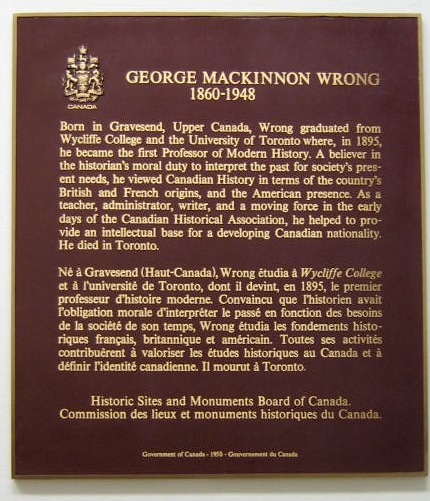
Federal Plaque - George MacKinnon Wrong
Benjamin Cronyn
(1802-1871) - Great-Grandfather of VBB
The Reverend Benjamin Cronyn was the first Bishop of Huron and the first
Anglican bishop to be elected by a Diocesan Synod in Canada. The Diocese of
Huron was one of seven diocese within the Anglican Church of Canada's
Ecclesiastical Province of Ontario, covered an area of 12, 000 square miles,
comprising the thirteen counties of southwestern Ontario.
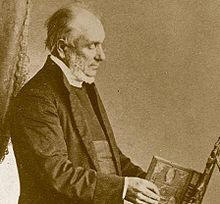
The Right Reverend Benjamin Cronyn
BENSON FAMILY
Thomas Benson (1804-1875) - VBB's great Grandfather (maternal)
Born in Ireland, Thomas Benson was a businessman and the
first mayor of Peterborough, Ontario during the early and mid-nineteenth
century. He married Alicia Maria Lowe and they had 12 children.
Thomas Benson
First Mayor of Peterborough
On the breaking out of the rebellion in 1837, Thomas
Benson went into the services as Captain of a Company of Volunteers, later held
a commission as Captain and Paymaster in the 3rd battalion of Incorporated
stationed at Niagara until it was disbanded in 1845. Benson moved to
Peterborough, where he was engaged in the milling business. He was the first
Mayor of Peterborough; and for many years, a member of the Council. He was
also Superintendent of Public Instruction for the Counties of Peterborough and
Victoria.
Thomas Benson moved to Port Hope, Ont. in 1853 and
assumed the duties of Secretary and Treasurer of the Peterborough and Port Hope
Railway Company. He was travelling on the business of this Company when he
met with his untimely end on the 12th of March, 1857, with fifty-seven other
passengers, by the breaking of the bridge over the Desjardin canal, on the line
of the Great Western Railway, near Hamilton.
Judge Thomas M. Benson (1833-1915) - VBB's Grandfather (maternal)
Thomas M. Benson , Barrister-at-law and a Bencher of the Law Society of Ontario,
was one of the leading men in his profession in the County of Durham.
Thomas
M.
Benson
married his second wife, Laura Abigail Fuller, the second daughter
of the Right Rev. Thomas Brock Fuller (the first Anglican Bishop of Niagara).
His Honour, Judge Thomas M. Benson of Port
Hope was one of the first members of the Provisional Board of Directors of
Ridley in 1888 and served on the Board from 1889 through 1915. The records show
that he first donated this prestigious Ridley award in 1891. His grandsons were
Gerald E. Blake and Verschoyle Benson Blake.
(Another family member was Clara Cynthia Benson, the first woman professor at
the University of Toronto).
Edward Francis Blake (1860-1905)
- Father of VBB
Edward (Ned) Francis Blake of Toronto
was the second son of the Hon. Edward Blake, Ontario premier and federal
Liberal Party leader.
He married Ethel Mary Benson (1867 - 1929)
of Port Hope
in Port Hope on May 18, 1891.
Edward Francis Blake worked in his father's law firm (Blake, Lash &
Cassels in Toronto) and became partner in 1891. When his father left
Canada to enter Irish politics in the 1890s, Ned was responsible for
managing family and business affairs. He also served on the board of
Ridley College, 1888, 1901-1905, where his two sons (Gerald and
Verschoyle) attended school. Ned Blake died of leukemia in September
1905.
Ethel
Mary
Benson Blake (1867- 1929)
Mother of V.B . Blake
Daughter of Judge Thomas M. Benson of Port Hope
Married to Edward Francis Blake (son of Edward Blake)
Four (4) children: Gerald Edward Blake (1892-1916), Mary
Margaret Blake (1893-1963), Ethel Constance Blake (1896-1979) and Verschoyle Benson Blake (1899-1971).
Never married, V.B. Blake was the last in his line of the
male branch of the Blake-Benson family tree.
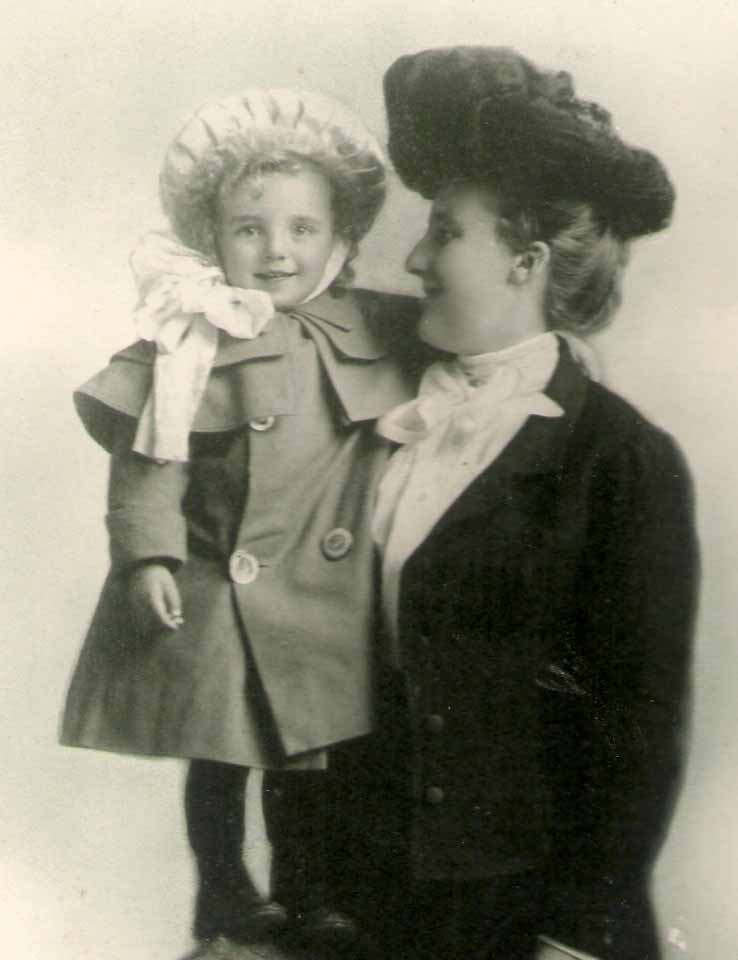
V.B. Blake with his Mother,
Ethel Mary Benson Blake, circa 1901
Photo courtesy of Elisabeth Bacque
Prosopography
In September, 2008, Professor Paul Litt, Public Historian at the
Ontario Heritage Foundation and a policy advisor for the Ontario Ministry of
Culture and a History Professor
at Carleton University was contacted and asked whether there
might be some meaningful correlation between the four men
(Blake-Wrong-Massey-McKenzie King) or were the facts only co-incidences,
i.e.
-
V.B. Blake was the grandson of Edward Blake – founder of the
Liberal dynasty and a National Historic Person of Canada;
-
Blake was related to George M.
Wrong, a Liberal who married Edward Blake’s daughter, Sophia (Prof.
Wrong also designated a National Historic Person of Canada);
Wrong and Blake were both well known historians and had country estates
north of Port Hope (Durham House and Ardfree);
-
Gov. Gen. Vincent Massey (designated as a National Historic Person of
Canada) was a former student of Prof. Wrong at the University of Toronto and
a Liberal. Massey later purchased part of Prof. Wrong's property in
Canton. Massey was well acquainted with Mackenzie King and C.D. Howe,
also Liberals;
-
MacKenzie King was also former student of Prof. Wrong at the University of
Toronto. (Mackenzie King was the longest serving Prime Minister in
Canadian History, elected three terms).
Mackenzie King also appointed Massey as High Commissioner to London
twice and Governor General
of Canada.
-
At the time of the Ganaraska project, the governments of the
day were all Liberal.
Professor Litt’s reply in September, 2008 was especially insightful:
“ What you
are saying about the possible connections between Blake and
Massey et. al. is very interesting. My instinct is that it all
makes sense that he was part of such a crowd—the pedigree, the
cultural interests, etc. all match. It reminds me of that
wonderful word “prosopography” which suggests that
researchers should pay attention to who their subject hung
around with because the cultural prejudices of peer groups are
the intellectual micro-climates in which they live day to day.
The Masseys and the Wrongs were related through marriage… King
certainly knew Massey…”
Professor Paul Litt
Prosopography - a study that identifies and draws relationships between various
characters or people within a specific historical, social, or literary context.
It also includes an investigation of the common characteristics of a
historical group - an independent science of social history embracing genealogy,
onomastics and demography. Prosopography permits the political history of
men and ‘events’ to be combined with the hidden social history of long-term
evolutionary processes.


Researcher: M. Martin
c2012